Prosperity
for our community.
Focus on opportunity and household prosperity, so more people can build their lives here and support the businesses and community organizations we value.
Ben Louwerse · My priorities
A prosperous Clearwater, a broader local economy, and practical ways to make good ideas possible—while preserving the character of the community we call home.
What will guide my work
Focus on opportunity and household prosperity, so more people can build their lives here and support the businesses and community organizations we value.
Look for simpler approval and permitting processes, help entrepreneurs find resources, and support practical ways to test new business ideas.
Encourage home-grown businesses and year-round opportunities alongside tourism, reducing our dependence on decisions made far from our valley.
01 · Practical ideas for Clearwater
Economic development matters when it creates opportunities for people who already live here, as well as those who choose to make Clearwater their home.
A new project can create construction work, permanent jobs, customers for local businesses, and additional assessed value to support municipal services. My focus is on the quality of those opportunities and the long-term value they bring to our community.
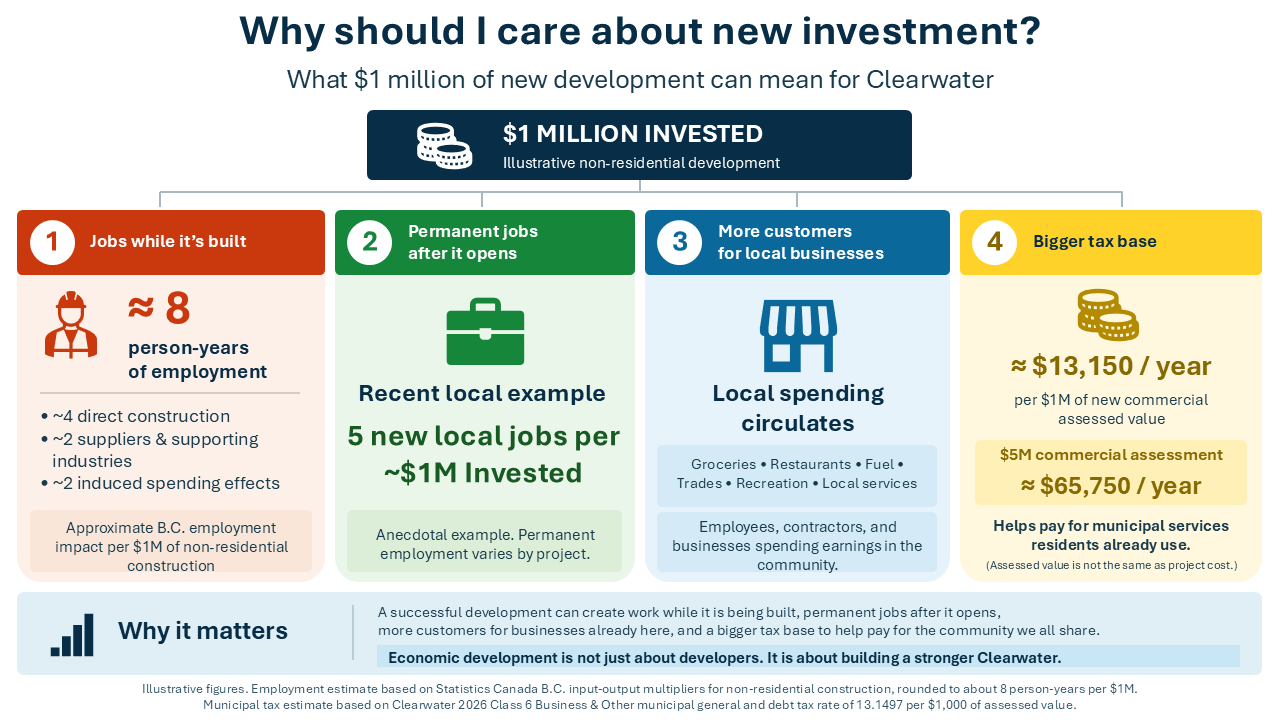
The graphic uses an illustrative $1 million non-residential investment. Its employment estimate is approximate; the permanent-job figure is an anecdotal local example. Municipal revenue depends on assessed value and the applicable tax rate, not simply the amount spent on a project.
02 · Practical ideas for Clearwater
Time spent waiting for an approval can make a good idea more expensive, or stop it from happening at all.
I want to explore better application guidance, more local or shared planning capacity, and practical digital tools. Clearer requirements, fewer administrative handoffs, and better tracking could help applicants and staff move work forward without lowering the standards a project must meet.
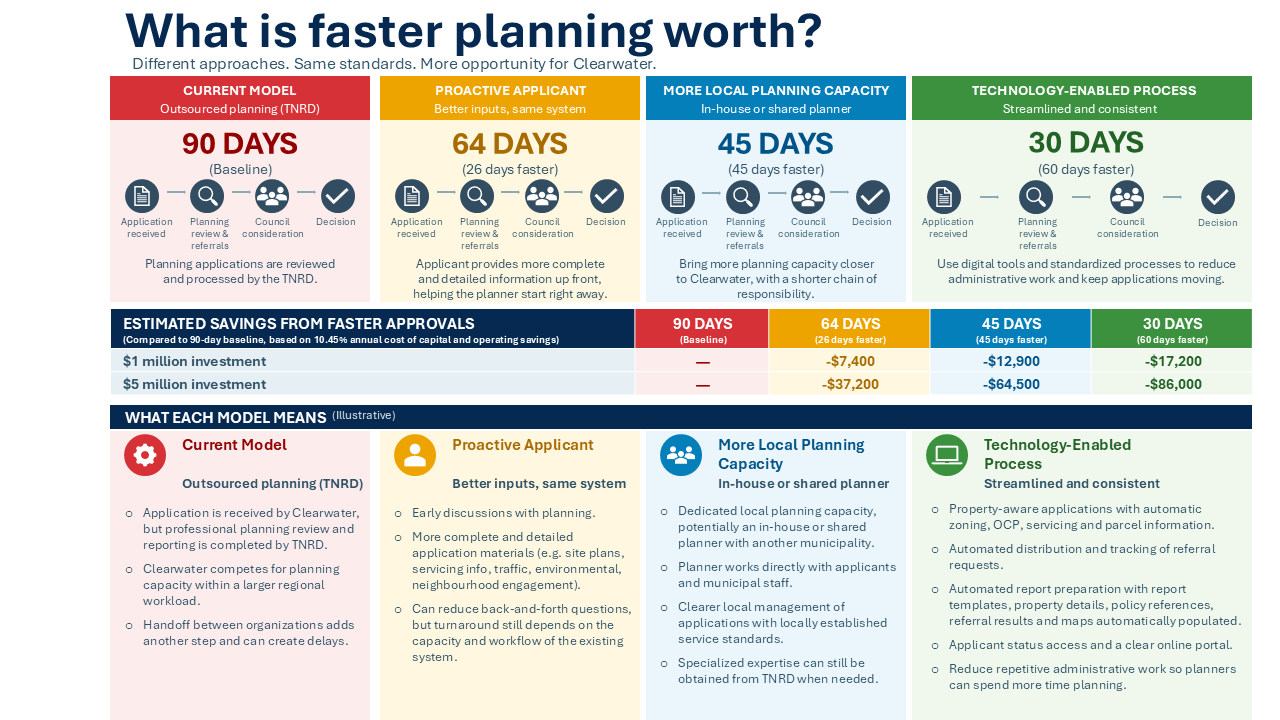
The 90-, 64-, 45- and 30-day scenarios are illustrative comparisons, not measured service commitments or guaranteed turnaround times. The savings shown use the graphic’s stated 10.45% annual cost assumption; actual costs and savings would vary.
03 · Practical ideas for Clearwater
A straightforward application that meets established requirements should have a clear path. Complex proposals deserve the time and scrutiny their impacts require.
The three-track concept separates compliant applications, applications needing limited discretion, and major policy changes or complex proposals. Grouping similar work could make expectations clearer, help identify bottlenecks, and give Council and the public more useful information about performance.
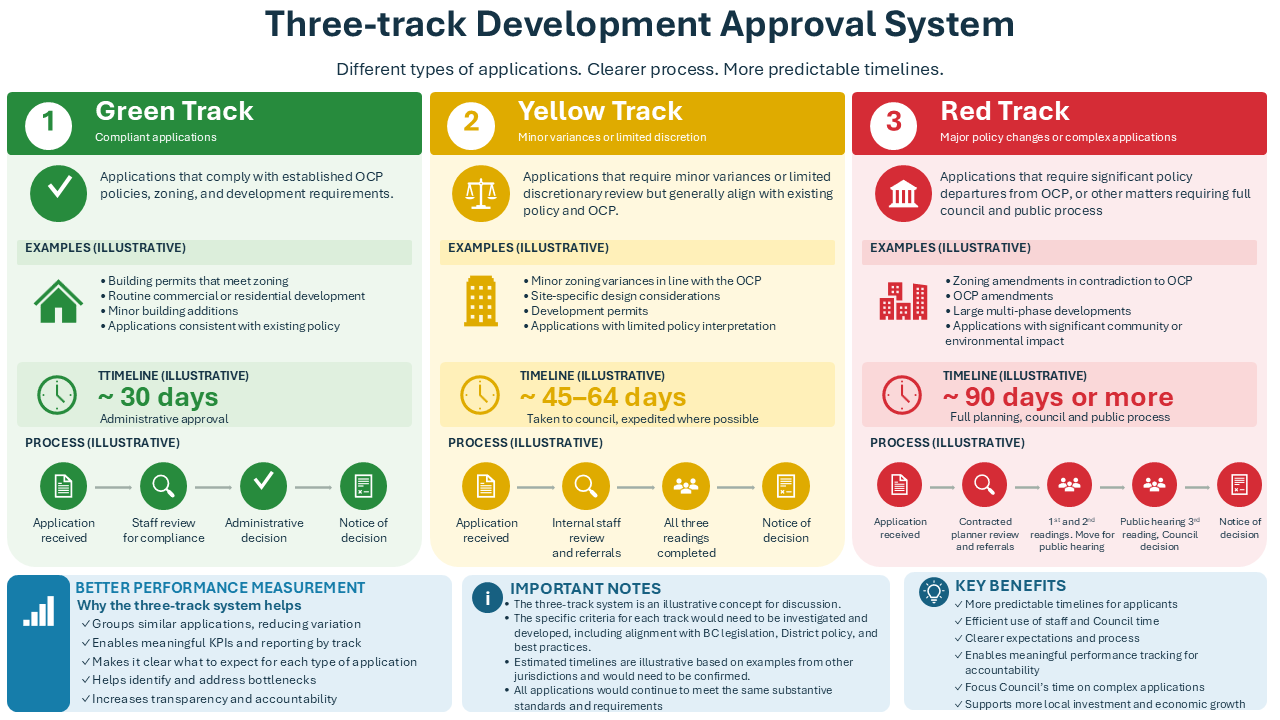
This is a proposal for discussion. Track criteria, delegated authority and timelines would need investigation and alignment with provincial legislation, District policy and required public processes. Every track would retain the applicable substantive standards.
04 · Practical ideas for Clearwater
Residents need a meaningful opportunity to understand proposals and participate when public input is required. The way notice is delivered should support that goal.
I want to examine whether modernizing public-notice methods could reduce avoidable scheduling delays while keeping residents informed. The graphic compares a newspaper-based process, alternative notice methods, and cases where a public hearing is not required. The appropriate process would depend on the application and the legal requirements that apply.
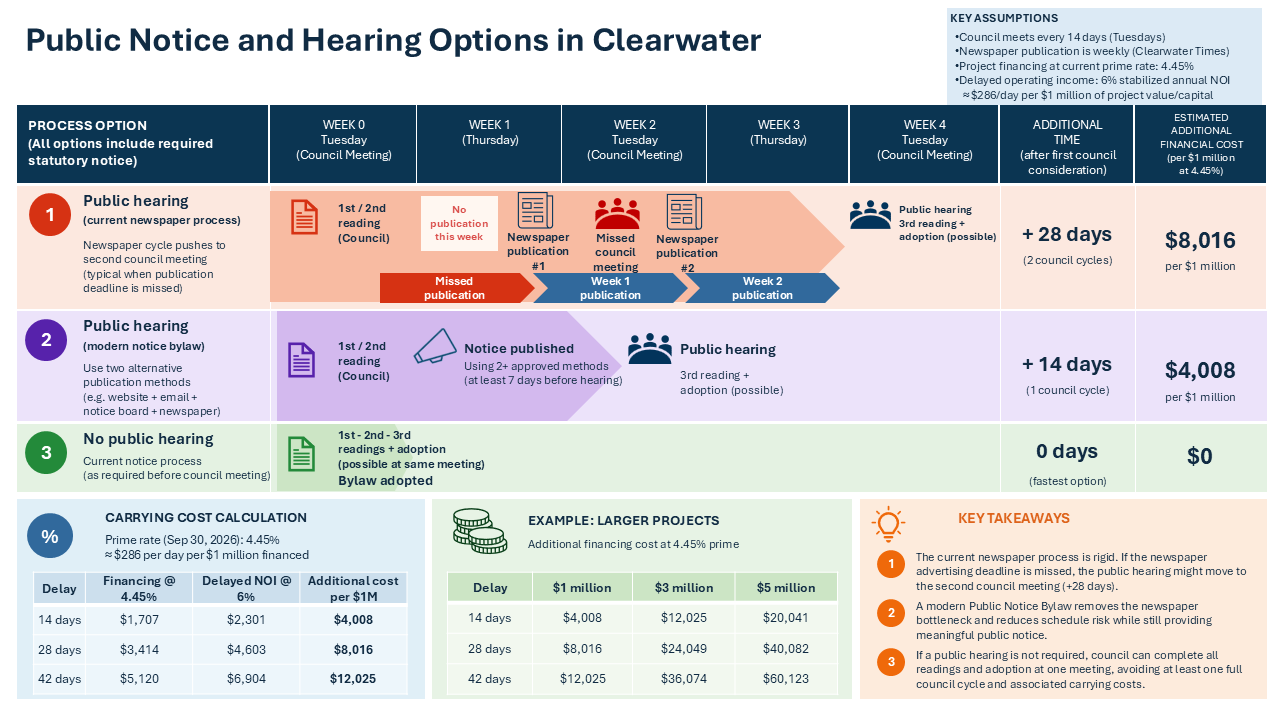
These are illustrative scenarios, not a statement that a hearing can be omitted for every application. The graphic assumes Council meetings every 14 days, weekly newspaper publication, 4.45% financing and 6% delayed net operating income. Its “additional financial cost” includes both financing and delayed income; it is not interest alone. Current requirements and any proposed notice bylaw would need to be checked before implementation.
Let’s talk about Clearwater’s future
Have a question about these ideas or an experience to share?
Contact me →